Introduction
Imagine walking into your home at night — hands full, keys fumbling — and the entrance light turns on automatically the moment you step inside. No fumbling for a switch. No stumbling in the dark. No wasted electricity because someone forgot to turn the light off.
This is the practical everyday magic of a motion sensor light — and in 2026, it is rapidly becoming standard in India’s thoughtfully designed homes rather than an unusual feature.
Primezen’s range of motion sensor switches and integrated sensor lights brings this intelligent functionality to Indian homes, apartments, offices, and commercial spaces across Vadodara and Gujarat.
How Motion Sensor Lights Work: The Technology
The most common technology in residential motion sensor lights is PIR (Passive Infrared) sensing.
PIR Sensor Technology
A Passive Infrared (PIR) sensor detects infrared radiation (heat) emitted by human bodies. When a person enters the sensor’s detection zone, the PIR element detects the change in infrared patterns as the warm body moves across its field of view — triggering the light.
“Passive” means the sensor does not emit anything — it only detects naturally emitted infrared radiation.
Key PIR specifications for residential use:
- Detection range: Typically 5–12 metres for residential sensors
- Detection angle: 90°–120° (wide angle) covers most room entry scenarios
- Sensitivity adjustment: Most sensors allow fine-tuning of sensitivity to reduce false triggers from pets
- Time delay: Adjustable hold-on time after last motion detected (typically 10 seconds to 10 minutes)
- Daylight sensor: Many PIR sensors include an ambient light (lux) sensor — activating only in darkness, preventing unnecessary triggering during the day
Microwave / Ultrasonic Sensors (Less Common in Residential)
Active sensors that emit microwaves or ultrasound and detect reflections. More sensitive than PIR — detect through walls and detect stationary presence. Better for commercial security applications; PIR is more appropriate for residential home automation.
Where to Install Motion Sensor Lights in Your Indian Home
The right placement transforms motion sensors from a novelty to a daily convenience. Here are the best locations:
1. Main Entrance / Door
Why: Hands-free activation when arriving home (especially with shopping, luggage). Automatic light-on for safety when entering after dark. Auto-off after you have moved inside — no wasted electricity.
Recommended sensor: PIR switch in ceiling or wall bracket; 10–30 second time delay.
2. Staircase
Why: One of the highest-value installations. Staircase accidents at night — particularly for elderly family members and children — are largely preventable with automatic staircase lighting.
Recommended sensor: PIR at the top AND bottom of stairs, controlling the same staircase light circuit; 1–2 minute time delay.
3. Corridor / Hallway
Why: Corridors in Indian homes and apartments are often the most-traversed spaces at night — bathroom trips, children moving around. Motion-activated corridor lighting eliminates the need to find and operate switches in the dark.
Recommended sensor: Ceiling PIR with wide detection angle covering the full corridor length; 1 minute time delay.
4. Bathroom (Night Light Circuit)
Why: A separate night-light circuit with PIR activation means the bathroom light comes on automatically for nighttime visits — no switch fumbling, no disrupting a partner with sudden full-brightness lights.
Recommended sensor: Low-sensitivity PIR (to avoid triggering for movement outside the bathroom); 2–3 minute time delay; connected to a warm, low-intensity night-light circuit rather than main bathroom illumination.
5. Garage / Parking Area
Why: Arriving home in a car, the garage light activates automatically. No dark fumbling. Security deterrent for any unwanted visitors.
Recommended sensor: PIR with 5-minute time delay; weatherproof if the area is semi-exposed.
6. Store Room / Utility Room
Why: Store rooms are used briefly and infrequently — and lights are frequently left on by mistake. Motion sensors in store rooms eliminate this entirely.
Recommended sensor: PIR with 2-minute time delay.
7. Children’s Room (Night Mode)
Why: Children’s bathroom visits at night. A low-level night light with motion activation provides safety guidance without fully waking the child.
8. Terrace / Balcony
Why: Evening use of outdoor spaces — lights activate when you step out, deactivate when you go inside. Also acts as a security deterrent.
Energy Savings from Motion Sensor Lights
This is one of the most compelling practical benefits in Indian homes where certain lights are frequently left on:
Calculation Example: Corridor Light
- Standard corridor light: 10W LED bulb
- Typical Indian household: Light ON 8–10 hours/day (often left on after nighttime use)
- With motion sensor: Light ON 30–60 minutes/day (only when needed)
- Annual electricity saving: 8.5 hours × 365 days × 10W = 31 kWh/year per corridor light
- At DGVCL tariff of ₹6.50/unit: ₹200/year savings per corridor light
Multiply across staircase, store room, bathroom, and garage — motion sensors across a typical Indian home save ₹1,000–₹3,000 annually in electricity costs.
Primezen’s Motion Sensor Products
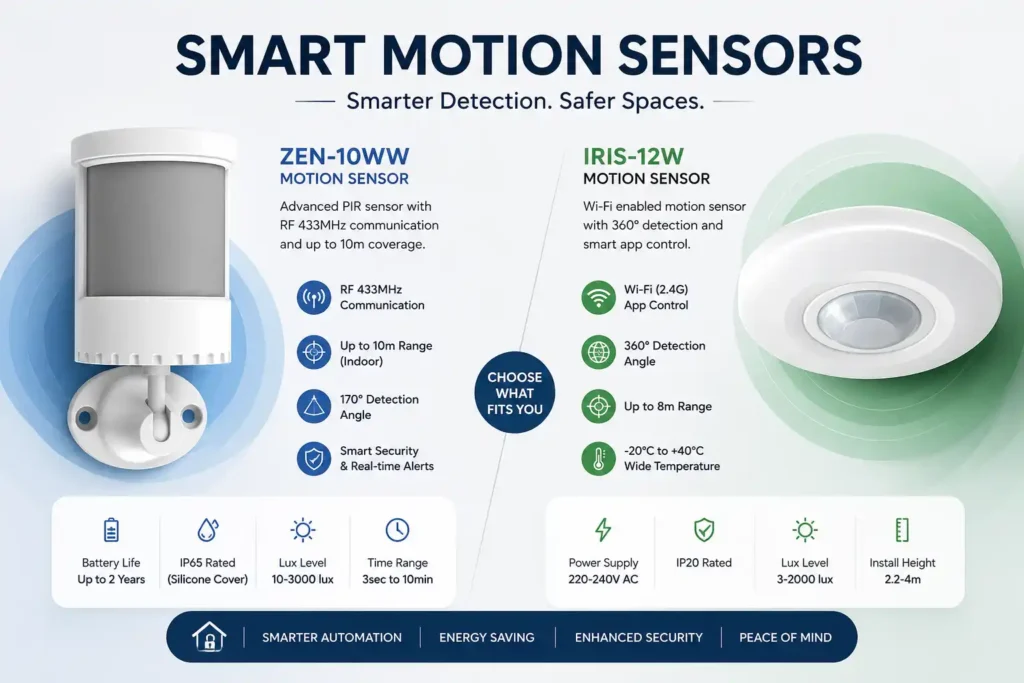
Primezen Zen-10WW (PIR Motion Sensor Switch)
- Integrated PIR sensor in a compact wall-mount switch format
- Works with existing light fittings
- Adjustable sensitivity, time delay, and ambient light threshold
- Easy to install in standard switchboard cutout
- Suitable for corridors, store rooms, bathrooms
Primezen IRIS-12W (Integrated PIR Sensor Light)
- Complete luminaire with integrated PIR sensor
- No separate switch required — sensor and light in one unit
- Ideal for garage, parking, entrance, terrace
- 12W output suitable for typical residential spaces
- Weather-resistant design for semi-outdoor use
Integration with Primezen Smart Home System
Both Primezen motion sensors are compatible with the Primezen Zen Gateway for full smart home integration — triggering scenes, notifications, and automations based on motion detection in addition to simple light control.
Frequently Asked Questions
Q1. Will a motion sensor light keep switching on and off?
With proper sensitivity and time delay settings, no. The time delay keeps the light on for your chosen duration after last detected motion — preventing rapid switching. Sensitivity adjustment prevents false triggers from fans, curtains, or pets.
Q2. Do motion sensors work with LED lights?
Yes — Primezen’s motion sensor switches are fully compatible with LED lights, including very low-wattage LEDs. Specify LED compatibility when selecting the sensor to avoid any minimum load issues.
Q3. Can I override a motion sensor to keep the light on continuously?
Yes — most PIR switch models include a manual override mode that keeps the light in continuous-on position when needed (e.g., during extended periods in a store room). Consult the product manual or ask your Primezen installer.
Q4. Do motion sensor lights work for elderly or slow-moving family members?
Yes — PIR sensors detect the infrared signature (body heat) rather than speed of movement. Elderly individuals moving slowly within the detection zone will reliably trigger the sensor.
Q5. Can I use motion sensors in air-conditioned rooms?
Yes, but with a note: extreme temperature differences (very cold AC rooms where body heat contrast is lower) can slightly reduce PIR sensitivity. Primezen’s sensors are calibrated for Indian climate conditions where this is not typically an issue.
Q6. Are Primezen motion sensors available for purchase in Vadodara?
Yes — Primezen products are available through authorised dealers across Vadodara and Gujarat. Visit primezen.in for nearest dealer information.
Conclusion
Motion sensor lights are one of the highest everyday-impact smart home features available — combining genuine safety, energy savings, and convenience in a simple, reliable product that works every time without any manual interaction.
In 2026, there is no good reason for Indian homes to have dark corridors, forgotten-on store room lights, or entrance fumbling in the dark. Primezen’s PIR motion sensor range makes all of this preventable, elegant, and affordable.
🌐 primezen.in | Contact Primezen for Vadodara dealer and installer details