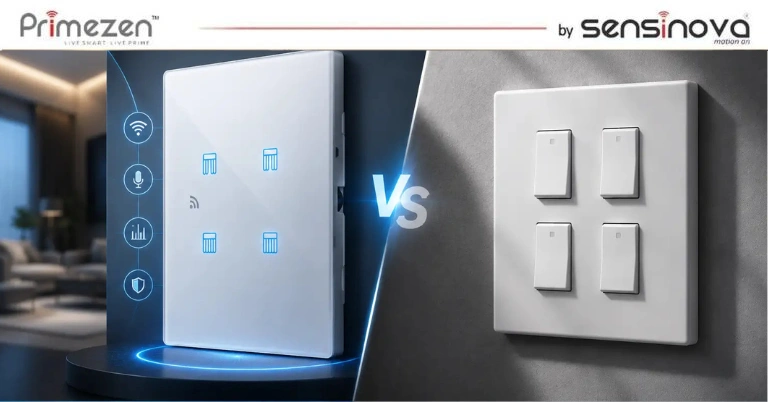
Introduction
You are renovating your home or shifting into a new flat. The electrician has come to finalise the switchboard layout and casually mentions — do you want regular switches or those fancy touch panels? You have seen smart switches at a friend’s place, or perhaps in a showroom. They look premium. But a small voice in the back of your head asks — is it really worth spending five to ten times more on a switch?
It is a completely valid question. And it deserves an honest, detailed answer — not a sales pitch.
In this blog, we put smart switches and normal switches side by side across every dimension that matters to an Indian homeowner — design, functionality, cost, energy efficiency, convenience, safety, and long-term value. By the end of this article, you will know exactly which one is right for your home and your lifestyle.
What is a Normal Modular Switch?
A normal modular switch is the standard electrical switch that has been used in Indian homes for decades. You physically press or toggle it to turn a device on or off. That is the full extent of its functionality.
Brands like Legrand, Havells, Anchor, GM, and Schneider Electric dominate this space in India. Normal modular switches are available in a wide range of prices — from budget options at ₹30 to ₹50 per switch point to premium modular systems that can cost ₹300 to ₹800 per module depending on the brand and finish.
They are reliable, straightforward, and universally available. Every electrician in India knows how to install and repair them. They require no internet, no app, no configuration. You press it — it works.
For decades, this was all a home switch needed to do. But the way we live has changed significantly, and the expectations we have of our homes have changed with it.
What is a Smart Switch?
A smart switch is an advanced electrical switch that does everything a normal switch does — and considerably more. It can be controlled by touch on the panel itself, remotely through a smartphone app from anywhere in the world, through voice commands via Google Assistant or Amazon Alexa, or automatically through pre-set schedules and triggers.
Smart switches connect to your home Wi-Fi network or to a home automation hub like the Primezen Zen Gateway. Once connected, they become part of a unified smart home ecosystem where devices can communicate, automate, and work together intelligently.
Primezen’s touch panel switches represent one of the best smart switch options available in India today. They feature a premium glass finish, capacitive touch controls, and are available in 2, 4, 6, and 8 module configurations — fitting standard Indian gang box sizes without any rewiring in most cases. They look like something from a luxury hotel, but they are designed and priced for real Indian homes.
Design and Aesthetics — The First Difference You Notice
Walk into a room with Primezen touch panel switches on the walls and the visual impact is immediate. The sleek, flat glass panel with subtle backlit touch icons is a world apart from the raised plastic toggles of a conventional modular switch.
Normal modular switches, even premium ones, have a functional, utilitarian look. They were designed to serve a purpose — not to enhance the visual appeal of a room. They work perfectly well but contribute nothing to the ambience or character of your interior.
Smart touch panel switches, on the other hand, are a design statement. They complement contemporary Indian interior design — whether minimalist, modern, or luxe. Interior designers and architects across India are increasingly specifying smart touch panels as a standard finish element in premium residential projects.
If you are spending lakhs on your home’s flooring, furniture, and kitchen fittings, the switches on your walls deserve the same attention to detail.
Functionality — Where the Real Gap Becomes Clear
This is where the comparison becomes genuinely one-sided.
A normal switch has exactly one function — manually turning a device on or off. Nothing more, nothing less.
A smart switch offers:
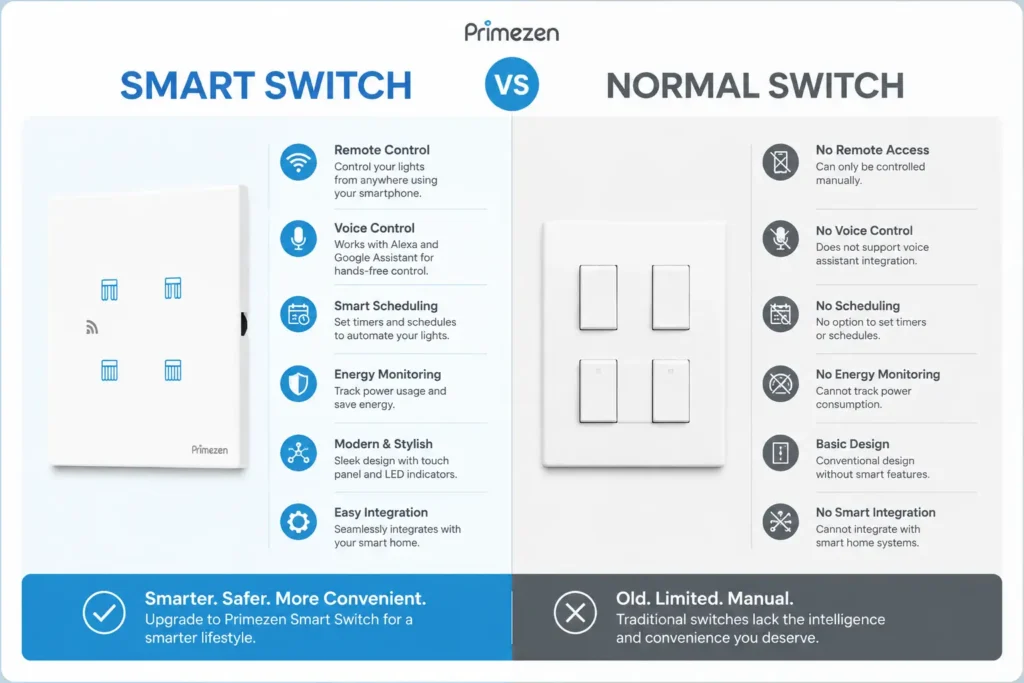
Remote control: Turn any device on or off from anywhere in the world using your smartphone. Left home and unsure if the geyser is on? Check the app and switch it off in seconds.
Voice control: Ask Google Assistant or Amazon Alexa to switch off the bedroom light, turn on the hall fan, or dim the living room lights — without moving from your sofa or bed.
Scheduling: Set your bathroom geyser to switch on automatically at 6:30 AM every morning. Schedule the living room lights to turn on at sunset and off at midnight. Once set, it happens every day without any input from you.
Scene control: Create one-tap scenes that control multiple devices simultaneously. A ‘Good Night’ scene can turn off every light in the house, switch off the hall fan, set the bedroom AC to sleep mode, and lock the front door — all with a single tap on your phone or a voice command.
Usage history: Know exactly how long each device has been running. Track your energy consumption patterns and identify which appliances are costing you the most electricity each month.
Child lock: Lock specific switch points so children cannot accidentally operate dangerous appliances like geysers or outdoor electrical points.
A normal switch does none of these things. Not even one.
Cost Comparison — The Full Picture
This is where most people stop comparing and go back to the normal switch. The upfront cost difference is real and it deserves honest discussion.
Normal modular switch (per module): ₹30 – ₹300 Smart touch panel switch (per panel): ₹1,800 – ₹6,500 depending on the number of modules
For a 2BHK home with roughly 10 to 14 switch panels, the cost difference could be anywhere between ₹25,000 and ₹60,000.
That is a significant number. But before you make a decision based on upfront cost alone, consider the complete financial picture.
Electricity savings: Smart scheduling and automation eliminate the habit of leaving devices on unnecessarily. Indian households that adopt home automation consistently report electricity bill reductions of 20 to 30 percent. On a monthly bill of ₹3,500, that is a saving of ₹700 to ₹1,000 per month — or ₹8,400 to ₹12,000 per year. The additional cost of smart switches in a 2BHK home could be recovered in electricity savings alone within three to five years.
Property value: Homes with pre-installed smart home systems command a premium of 5 to 10 percent in the Indian real estate market, particularly among buyers aged 30 to 45 who are actively seeking smart-ready homes. On a ₹70 lakh apartment, that is a potential value addition of ₹3.5 to ₹7 lakhs — many times the cost of the smart switches themselves.
Replacement and maintenance: Normal modular switches are mechanical devices. The moving parts wear out over time and switches need to be replaced periodically. Smart touch panel switches use capacitive touch technology with no mechanical parts — they last longer and require virtually no maintenance.
When you account for all of these factors, the cost argument against smart switches becomes much weaker than it initially appears.
Installation — Easier Than You Think
One of the most common concerns about smart switches is that they require complex installation or rewiring. This is a misconception worth addressing directly.
Primezen touch panel switches are designed to fit standard Indian electrical gang boxes — the same boxes your existing modular switches sit in. In most homes, installation involves removing the existing switch, connecting the wires to the smart panel, and completing the app setup. No new wiring, no civil work, no drilling.
Most configurations do not require a neutral wire, which is important because many older Indian homes do not have neutral wires running to switch boxes. Primezen’s team or their certified installation partners will confirm compatibility during a pre-installation check.
The entire installation of a complete 2BHK home — including app setup, gateway configuration, and a walkthrough of how to use your new smart home — typically takes four to six hours.
Reliability — Does a Smart Switch Work When the Internet is Down?
This is a question every sensible buyer should ask before purchasing smart home devices.
Normal switches work regardless of power conditions as long as there is electricity — obviously. They have no dependency on internet or connectivity.
Primezen smart switches, when paired with the Primezen Zen Gateway, support full local control. All device communication happens within your home’s local network. If your internet service provider has an outage, your smart switches continue to function normally — through touch control on the panel, through the app on your local Wi-Fi, and through all your automated schedules.
The only functionality that requires active internet is remote control from outside your home network — for example, turning off the geyser while you are at the office. For everything else, your smart home is self-sufficient.
Which Rooms Benefit Most from Smart Switches?
Not every switch point in every home needs to be smart. Here is a practical guide on where smart switches deliver the most value:
Living room: Highest impact. Scene control, mood lighting, one-tap all-off before leaving home, integration with curtains and entertainment.
Master bedroom: Second highest impact. Sleep schedules, AC automation, morning scene with curtain opening and gentle lighting, child lock on specific points.
Home entrance and hallway: High impact. Motion-triggered lighting, all-off scene when leaving, welcoming scene when arriving.
Kitchen: Moderate impact. Smart plugs are often more useful here than smart switches, but scheduling the exhaust fan and lighting adds genuine convenience.
Bathrooms and corridors: Best served by motion sensors rather than smart switches. The automation value comes from motion-triggered lighting rather than remote or scheduled control.
Storeroom, utility area, servant quarters: Lowest impact. Standard modular switches work perfectly well in these spaces.
A practical hybrid approach — smart switches in living areas and bedrooms, normal switches in utility and infrequently used spaces — gives you the best combination of value and cost efficiency.
Smart Switch vs Normal Switch — Side-by-Side Summary
Control method: Normal switch — manual only. Smart switch — touch, app, voice, and schedule.
Remote access: Normal switch — not possible. Smart switch — full remote control from anywhere.
Energy monitoring: Normal switch — not available. Smart switch — available on select models.
Scene and automation: Normal switch — not possible. Smart switch — unlimited scenes and automation.
Design: Normal switch — functional plastic finish. Smart switch — premium glass panel, multiple colour options.
Voice assistant support: Normal switch — none. Smart switch — Google Assistant and Amazon Alexa compatible.
Works without internet: Normal switch — yes. Smart switch — yes, with local control via gateway.
Lifespan: Normal switch — 5 to 10 years (mechanical wear). Smart switch — 10 to 15 years (no mechanical parts).
Upfront cost: Normal switch — low. Smart switch — moderate to high.
Long-term value: Normal switch — low. Smart switch — high, with electricity savings and property value uplift.
Frequently Asked Questions
Q. Can I replace just a few switches in my home with smart switches and keep the rest normal?
Absolutely. You do not need to replace every switch at once. Many homeowners start with the living room and master bedroom, then add more rooms gradually. Primezen’s system is fully scalable.
Q. Will a smart switch work with my existing fan regulator?
Smart switches can control fans on a simple on/off basis. For fan speed regulation, Primezen offers dedicated smart fan controllers that replace existing regulators and give you full speed control through the app.
Q. Do smart switches require a Wi-Fi router nearby?
Smart switches connect to your home Wi-Fi network. As long as your Wi-Fi signal reaches the room — which it typically does in most Indian apartments — the switch will work without any issues. In larger homes, a mesh Wi-Fi network or a Zigbee-based gateway ensures coverage throughout.
Q. What happens to my smart switch settings after a power cut?
Primezen smart switches restore to their last known state when power returns. All schedules, scenes, and automation rules are stored on the gateway and resume automatically after any power interruption.
Q. Is it safe to install smart switches in Indian homes with voltage fluctuations?
Yes. Primezen smart switches are built for Indian electrical conditions and include built-in protection
Conclusion
The honest answer to the question of smart switch vs normal switch is this — it depends entirely on how you want to live in your home.
If you are comfortable with manually controlling every device, have no interest in remote access or automation, and want the lowest possible upfront cost on your switchboards — normal modular switches are a perfectly sensible choice.
But if you want a home that responds to your lifestyle, saves electricity without any effort from your side, gives you peace of mind when you are away, and looks genuinely impressive every single day — a smart switch is not just worth it. It is one of the best investments you will make in your home.
The gap in upfront cost is real but it is far smaller than the gap in what these two switches actually do for your life.
Explore Primezen’s full range of smart touch panel switches at www.primezen.in — and see which model is right for your home.