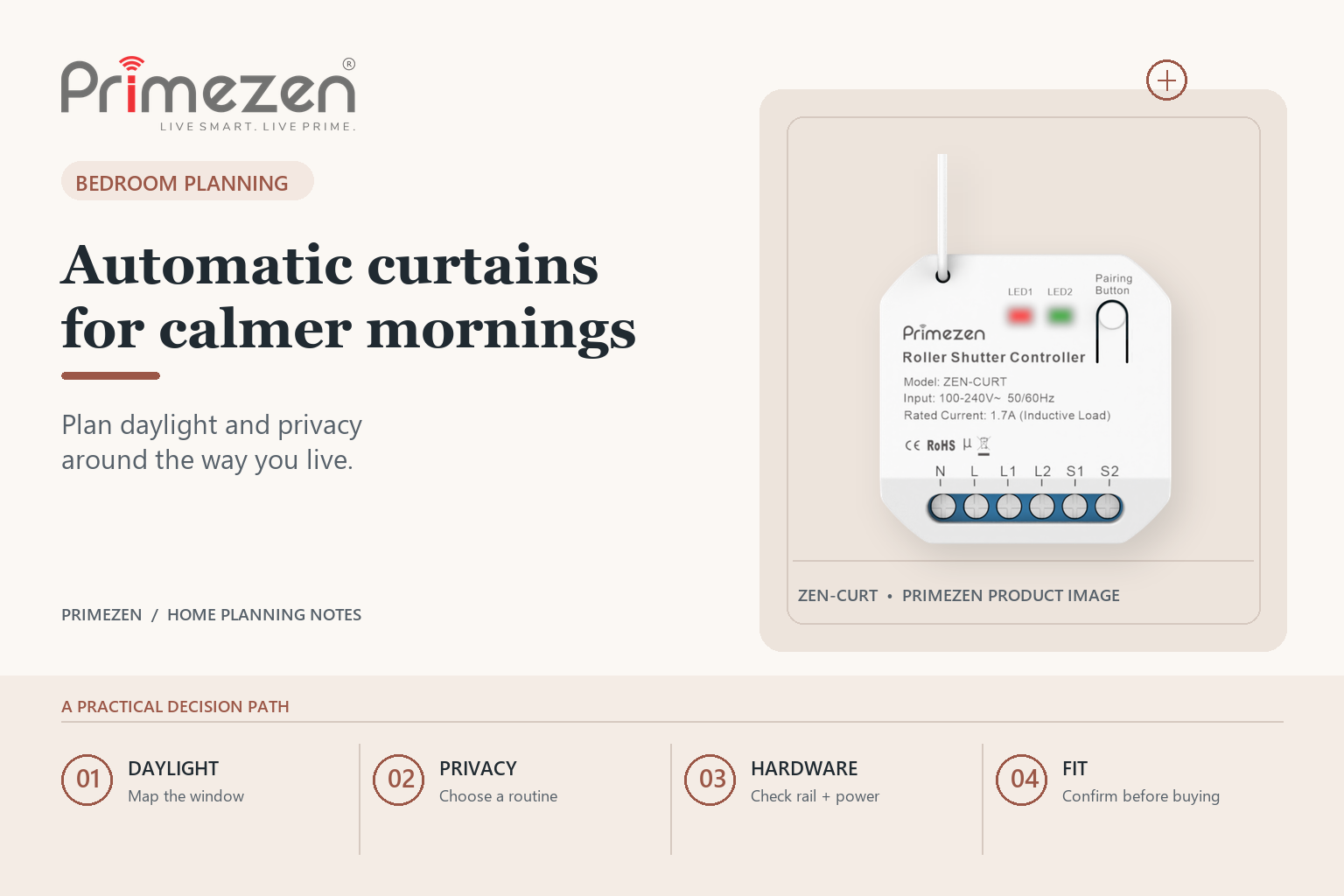
Automatic curtains for bedrooms make the most sense when the plan starts with privacy, not a motor. Before choosing controls, look at what a neighbour can see after dark, where morning light falls, and how the fabric will sit beside the bed. PrimeZen’s curtain controller for motorized curtains offers app and voice control plus scheduling; the useful question is how to apply those options to your particular bedroom.
Automatic curtains for bedrooms start with privacy
Stand at the window at the times you actually use the room. A balcony opposite yours may have a direct sightline when the lights are on, even if the room feels secluded in daylight. In an apartment, check the view from neighbouring balconies, the building across the lane and any shared corridor facing a window. Do this with the room lights on at night as well as during the day. A daytime look alone is a poor privacy test.
Now decide what “closed” needs to mean. A sheer layer can soften a view and admit daylight, but it may not provide the night-time privacy you expect. A denser curtain may be more appropriate where the bed faces an exposed window. If you want both options, discuss the number of curtain layers and their separate movement with the installer rather than assuming one control will operate every arrangement. Automatic curtains for bedrooms should follow the privacy requirement of each opening, not a single setting copied across the flat.
Map daylight to the way you sleep
A bedroom facing the morning sun has a different job from one that stays dim until afternoon. Note when light first reaches the pillow, whether glare falls on a work desk, and when the window becomes useful for ventilation or a view. If one person leaves early and another sleeps later, a scheduled opening for the whole room may be more disruptive than helpful. Agree on a routine first, then decide whether scheduling belongs in it.
For automatic curtains for bedrooms, a practical routine can have two distinct moments: a morning position that welcomes light when everyone is ready, and an evening close that protects privacy before the room lights come on. Treat these as planning examples, not guaranteed preset positions for any specific installation. Ask how the selected motorized system and controller handle the movements you want. Keep a simple way to change the routine when shifts, holidays or seasons alter your schedule. If the bedroom routine should connect with controls in other rooms, review the home automation gateway with PrimeZen and ask which components that plan requires.
Measure the space around the window, not just the glass
A bedroom window often competes with a wardrobe, split AC unit, ceiling fan, dressing table or balcony door. Draw the entire wall and mark the space where fabric gathers when open. Check whether a bedside table, curtain pelmet or door swing will obstruct the moving curtain. In a compact flat, a beautifully centered window treatment is of little use if it blocks access to the wardrobe or leaves the balcony door awkward to use.
Also inspect the top of the opening. Record whether there is a false ceiling, a recess or an existing rail, and note where electrical provision could be made. An existing manual rail is not proof that it can be reused with a motorized setup. Ask for a site-specific assessment of the rail, motor, mounting surface and power arrangement before ordering anything. This is especially important in a rented apartment or a finished bedroom where changes to the ceiling and wall may need permission.
A placement checklist to take to a site visit
- Which windows need full night-time privacy, and from which outside viewpoints?
- When does direct daylight reach the bed, desk and dressing area?
- Where will the curtain stack when open, and will it obstruct a door or furniture?
- Is there a pelmet or false-ceiling recess, and can the mounting surface support the proposed arrangement?
- What motorized curtain system and power provision are planned? Can any existing rail actually be reused?
- Does the chosen fabric clear window handles, AC airflow paths and balcony access?
- Who needs control, and what should happen when a schedule is inconvenient?
Bring photographs and rough dimensions to the conversation, but leave final fit and wiring decisions to an on-site check. PrimeZen describes app, voice, scheduling and automation scenes for its curtain controller. Ask which components are required for the intended controls in your particular bedroom; do not assume that a controller alone supplies every connected feature.
Plan separately for apartment constraints
Automatic curtains for bedrooms in apartments need to account for both the room and the building. A high-rise balcony may make a curtain panel swing near an open door. A narrow recess may restrict how much fabric can gather at the side. Shared walls and limited ceiling access can affect where an installer can work. None of these automatically rules out a project, but each changes what you should confirm before selecting hardware or fabric.
If you own the flat, check the actual window opening and surrounding finishes before scheduling work. If you rent, ask the owner or building manager what mounting and electrical changes are allowed. Keep a record of where the proposed hardware would go and whether removal later would leave marks. These are practical questions for the installation plan, not promises that any particular arrangement will be damage-free or suitable for every apartment.
Think in rooms rather than floors. A primary bedroom exposed to neighbouring towers may need an earlier close than a guest bedroom overlooking an internal courtyard. A child’s room may need a routine that does not open curtains before the family is awake. One apartment-wide command sounds tidy, but automatic curtains for bedrooms are most useful when each room’s privacy and sleep habits have been considered.
Match fabric and movement to the job
Choose the fabric based on the light and privacy you need, then discuss whether the selected motorized curtain system can move that fabric as intended. Consider where the panels meet in the middle, how far they extend beyond the window and whether gaps at the sides allow unwanted light or visibility. A good photograph taken at midday cannot tell you how the finished room will feel with indoor lights on at night.
If you are considering two layers, describe what each layer should do: a lighter daytime layer for a softer view and a more private layer for evening, for example. Ask the installer to confirm how each proposed layer would be mounted and controlled. Do not assume independent control, a specific fabric weight capacity or compatibility with an existing track without a confirmed configuration. Automatic curtains for bedrooms should be designed around the actual window treatment, rather than a generic promise about rails.
Choose controls around real habits
PrimeZen presents its curtain controller as a way to operate motorized curtains through app and voice commands, with scheduling and automation scenes. That creates several possible ways to use a bedroom, but more controls are not automatically better. If a household member prefers to close the curtains before changing clothes, make that action easy and predictable. If voice commands would disturb someone sleeping, discuss a quieter interaction pattern for that household. Set schedules only after you have lived with the room’s light and privacy pattern for a few days.
Write down the desired behaviour in plain language: “close before the opposite building can see in” is more useful than “smart privacy.” Decide who can change the schedule, what should happen when guests stay over, and whether the curtains should remain closed on a late morning. Ask the provider to demonstrate the proposed controls with the actual planned components. The product page outlines capabilities; an installation proposal should establish how they apply to your bedroom.
Questions to settle before approving the plan
- Which exact openings are included, and does each one need the same fabric and routine?
- Where will the curtain gather when open, and how will it affect doors, cupboards and views?
- What motorized system, mounting arrangement and power work are required for each window?
- Which app, voice or scheduled actions will be available in the proposed configuration?
- What will be tested on site for full closing, side gaps and night-time privacy?
These questions keep the discussion anchored to the room rather than to a list of generic smart-home benefits. For automatic curtains for bedrooms, a successful plan is one you can explain to everyone who sleeps there: when the fabric moves, how to change it, and what the room looks like from outside after dark.
Frequently asked questions
Are automatic curtains for bedrooms worthwhile in a small apartment?
They may be, but size alone does not decide it. First check the sightline into the room, where the fabric will stack and whether furniture or a balcony door limits movement. A site assessment should confirm the proposed mounting and motorized system before you commit.
Can I use my existing bedroom curtain rail?
Do not assume so. The existing rail, motor, fabric, mounting and power provision must be assessed together. Ask the installer whether the rail can be retained or whether a different arrangement is needed.
Should bedroom curtains open automatically every morning?
Only if that timing suits the people in the room. Morning light, shift work and different wake-up times may make a fixed schedule inconvenient. Plan the routine first and confirm how you can change it in the proposed setup.
Do I need a gateway for app or voice control?
PrimeZen describes its gateway as a bridge for connected app, voice and scene functions. Ask the team to specify the components needed for your exact curtain installation rather than assuming a particular feature is included with every controller or motorized track.
The best next step is a window-by-window plan with photos, measurements, privacy sightlines and your preferred daily routine. If you are comparing automatic curtains for bedrooms in an Indian flat, contact PrimeZen with those details and ask for a configuration and installation assessment specific to your rooms.