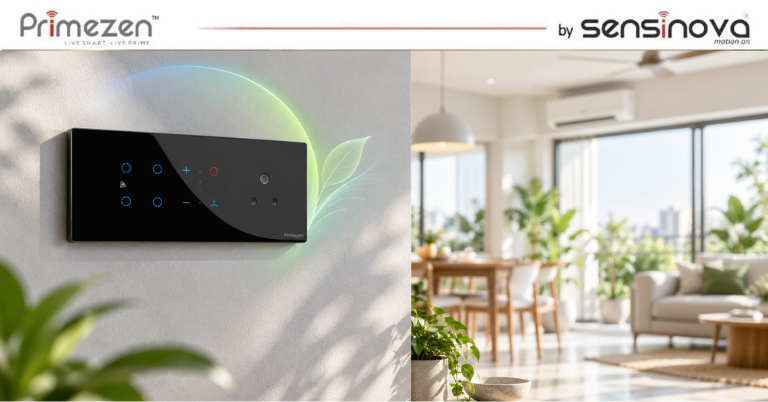
Electricity consumption is becoming an important consideration for homeowners, offices and commercial spaces.
While replacing conventional bulbs with energy-efficient lighting can reduce electricity consumption, the way lights are controlled also matters.
Lights are often left switched on in empty rooms, corridors, bathrooms, balconies and other areas where they are not required. In many homes, people also forget to turn off lights when leaving for work or going to bed.
This is where smart switches for energy saving can make a practical difference.
Smart switches allow lighting to be controlled through schedules, automation, remote access, sensors and other intelligent controls. The objective is simple: use lighting when it is needed and avoid unnecessary operation when it isn’t.
The Bureau of Energy Efficiency (BEE) has specifically examined home-automation technologies for residential energy efficiency, including smart lighting with scheduling, dimming and remote-operation features.
Can Smart Switches Actually Save Electricity?
Yes, but there is an important distinction.
A smart switch does not automatically make a light fixture energy efficient.
Instead, it can help reduce electricity consumption by improving how and when the light is operated.
For example:
A conventional switch may leave a light running for several hours because someone forgot to turn it off.
A smart switching system can potentially:
- Turn lights off according to a schedule
- Turn lights off remotely
- Control lights according to occupancy
- Reduce brightness through dimming
- Create automatic lighting scenes
- Reduce unnecessary operating hours
ENERGY STAR also identifies scheduling, remote control and occupancy-based control as ways smart lighting systems can help manage energy use.
So the energy-saving benefit comes primarily from better control, rather than the word “smart” itself.
How Do Smart Switches Help Reduce Energy Consumption?
There are several ways smart switches and intelligent lighting controls can reduce unnecessary lighting usage.
1. Automatic Scheduling
One of the simplest ways to reduce wasted electricity is to make sure lights don’t stay ON longer than necessary.
With scheduling, lights can be programmed to operate during specific periods.
For example:
Garden lights:
ON → 6:30 PM
OFF → 11:00 PM
Porch light:
ON → Evening
OFF → Morning
Office lighting:
ON → Working hours
OFF → After closing
This can prevent lights from being accidentally left on overnight or during periods when the space is not being used.
2. Remote Control
Have you ever left home and suddenly remembered:
“Did I turn off the lights?”
With connected smart switches, users can potentially check and control compatible lighting remotely.
This is useful for:
- Homes
- Offices
- Shops
- Holiday homes
- Rental properties
ENERGY STAR highlights remote control as one of the useful functions of connected lighting for avoiding unnecessary operation.
Instead of keeping a light ON for hours because nobody is available to switch it off manually, the user can control it remotely.
3. Occupancy-Based Lighting
This is one of the more effective applications of intelligent lighting control.
An occupancy or motion sensor can detect whether a space is being used.
For example:
Person enters bathroom → Light ON
Person leaves → Light OFF after a set period
The same concept can be used for:
- Passageways
- Staircases
- Store rooms
- Bathrooms
- Utility areas
- Parking areas
- Offices
BEE’s national roadmap for residential home automation estimates significant savings potential from occupancy sensors and specifically discusses occupancy-based lighting control.
However, sensor placement and settings matter. A poorly positioned sensor can cause lights to switch off when someone is still in the room.
So installation quality is just as important as the technology.
4. Dimming Instead of Full Brightness
Not every situation requires lighting at 100% brightness.
A smart lighting system with dimming capability can reduce the light output when full brightness isn’t required.
For example:
Evening Relaxation
Instead of:
100% brightness
the lighting could be:
50–60% brightness
This can reduce the energy used by the lighting system while creating a more comfortable environment.
BEE’s smart-lighting analysis specifically considers scheduled dimming as one of the mechanisms through which smart lighting can reduce energy consumption.
However, dimming capability depends on the light source and compatible hardware. A smart switch alone cannot guarantee that every connected light can be dimmed.
5. Daylight-Based Lighting Control
Another useful approach is to avoid using artificial lighting when enough natural light is already available.
Consider a room with large windows.
During the afternoon, sunlight may provide enough illumination.
Instead of keeping artificial lights at full brightness, an intelligent lighting system can use daylight information or suitable sensors to adjust lighting.
This approach is often referred to as daylight harvesting.
BEE materials on energy-efficient buildings identify daylight sensors and occupancy sensors as lighting-control strategies for reducing energy consumption.
6. Create Energy-Saving Lighting Scenes
Smart switches and touch panels can also combine multiple lighting controls into a single scene.
For example:
Leaving Home
One command can:
- Turn OFF living room lights
- Turn OFF bedroom lights
- Turn OFF kitchen lights
- Turn OFF selected appliances
Good Night
A night scene could:
- Turn OFF most lights
- Keep selected pathway lights ON
- Reduce bedroom lighting
Movie Mode
The system could:
- Dim the main lights
- Turn off unnecessary lights
- Keep ambient lighting at a lower level
The advantage isn’t simply convenience.
By combining multiple controls into predefined scenes, homeowners can make energy-efficient behaviour easier to follow every day.
Smart Switches vs Traditional Switches for Energy Saving
So, is a smart switch actually better than a traditional switch?
It depends on how you use it.
Feature | Traditional Switch | Smart Switch |
Manual ON/OFF | ✓ | ✓ |
Remote control | ✗ | ✓ |
Scheduling | ✗ | ✓ |
Automation | Limited | ✓ |
Occupancy-based control | ✗ | Possible |
Dimming | Depends on hardware | Possible |
Lighting scenes | ✗ | ✓ |
App control | ✗ | ✓ |
Energy-management integration | Limited | Possible |
A traditional switch can still control a light efficiently if the user consistently turns it off when it isn’t required.
The advantage of a smart switch is that it can automate some of this behaviour.
How Much Electricity Can Smart Switches Save?
This is where you need to be careful.
There is no universal percentage of electricity savings for every smart switch installation.
The actual savings depend on:
- Number of lights
- Lighting wattage
- Daily operating hours
- Existing user behaviour
- Use of sensors
- Scheduling
- Dimming
- Type of lighting
- Room occupancy
- Installation quality
For example, a household where lights are already switched off consistently may see relatively little additional savings.
On the other hand, a home or office with frequently forgotten lights could have more opportunity for savings.
BEE’s analysis of smart lighting uses a specific scenario involving scheduled dimming and prevention of idle running and calculates savings under those assumptions; it should not be interpreted as a guaranteed saving for every installation.
That’s why claims such as “smart switches will reduce your electricity bill by 50%” should be treated with skepticism unless they are backed by a specific installation analysis.
Smart Switches Are Not a Replacement for Energy-Efficient Lights
This is an important point.
Suppose you have a 20W light that runs unnecessarily for several hours.
A smart switch can help reduce the number of hours it operates.
But if you replace inefficient lighting with an efficient LED and then add intelligent controls, you can address both sides of the problem:
Efficient lighting → Less electricity per hour
Smart control → Fewer unnecessary operating hours
That combination is generally more meaningful than relying on smart controls alone.
ENERGY STAR also separates efficient lighting products from lighting controls while recommending both as part of broader energy-saving strategies.
Where Should You Use Smart Switches for Energy Saving?
Smart switching can be particularly useful in areas where lights are frequently forgotten or where occupancy changes throughout the day.
At Home
- Living room
- Bedroom
- Kitchen
- Bathroom
- Balcony
- Entrance
- Staircase
- Garden
- Garage
In Offices
- Meeting rooms
- Cabins
- Corridors
- Reception
- Washrooms
- Storage rooms
- Common areas
In Commercial Spaces
- Restaurants
- Retail stores
- Hotels
- Showrooms
- Clinics
- Educational institutions
The right control strategy depends on how each space is used.
For example, a bathroom may benefit from occupancy-based control, while a garden may be better suited to scheduling.
Can Touch Panels Also Help With Energy Saving?
Yes.
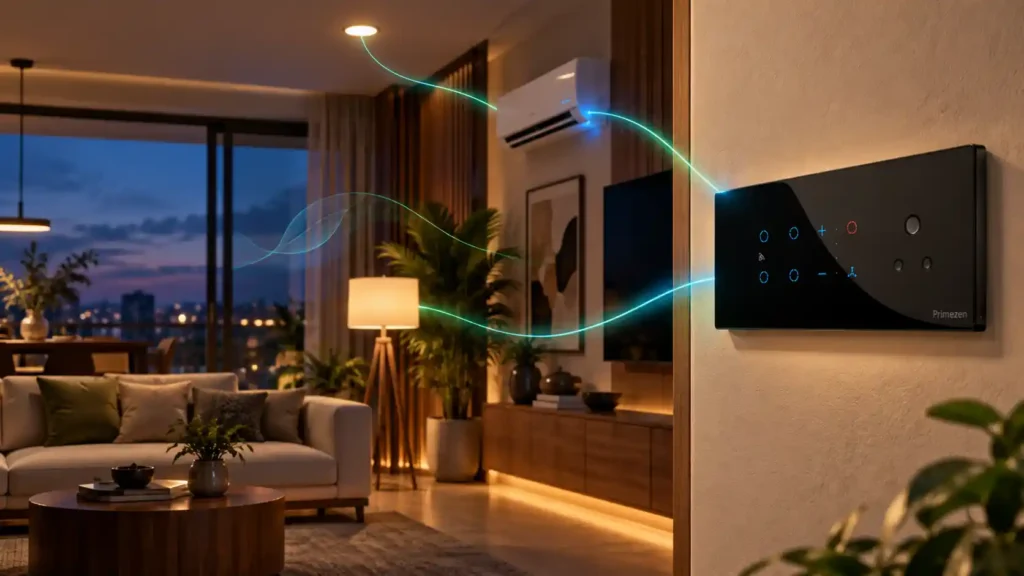
A touch panel can act as a centralized interface for controlling multiple lighting zones and scenes.
Instead of having separate controls scattered across different switchboards, a touch panel can provide access to multiple functions from one interface.
For example:
Touch Panel → Living Room Lights → Bedroom Lights → Curtains → Scenes → Other Connected Devices
This can be particularly useful in larger homes and premium interiors where multiple automation functions need to be managed from a single location.
However, the touch panel itself isn’t what creates the energy savings.
The savings come from the control strategy behind it — scheduling, dimming, occupancy detection, remote control and reducing unnecessary operation.
Are Smart Switches Worth Installing in a New Home?
If you’re already building or renovating a home, it can be worth considering smart switching during the electrical-planning stage.
Planning early gives you the opportunity to consider:
- Wiring
- Switchboard size
- Neutral-wire requirements
- Load compatibility
- Sensor locations
- Touch-panel locations
- Lighting zones
- Automation requirements
Retrofitting later can sometimes be more complicated depending on the existing electrical installation.
For larger projects, designing the electrical and automation system together can also help avoid unnecessary rewiring.
What to Check Before Buying Energy-Saving Smart Switches
Don’t choose a product simply because it says “smart”.
Before buying, check:
1. Compatibility
Make sure the switch works with your preferred smart-home ecosystem.
2. Wiring
Check whether a neutral wire is required.
3. Load Capacity
Confirm that the switch can safely handle the connected lighting load.
4. Dimming Support
If you need dimming, verify compatibility between the switch and the lighting fixture.
5. Sensor Compatibility
If occupancy-based automation is required, check whether sensors are built in or need to be added separately.
6. Automation Features
Look for scheduling, scenes, remote control and other functions relevant to your requirements.
7. Installation
Smart electrical products should be installed according to the manufacturer’s requirements by a qualified professional.
The Bottom Line: Do Smart Switches Reduce Electricity Bills?
They can, but they aren’t magic electricity-saving devices.
Smart switches help by giving homeowners better control over when and how lighting operates.
The biggest opportunities generally come from:
Scheduling + Occupancy Control + Dimming + Remote Control + Efficient Lighting
For a home where lights are already used efficiently, the additional savings may be modest.
For spaces where lights are regularly left ON unnecessarily, intelligent controls can have much greater value.
The real benefit of smart switches is therefore not just automation.
It is automation that helps eliminate unnecessary energy use without making everyday life less convenient.
Upgrade Your Home With Smarter Lighting Control
Modern homes need more than attractive switchboards. They need electrical controls that combine design, convenience and intelligent functionality.
With the right combination of smart switches, touch panels, sensors and automation, homeowners can create lighting systems that are easier to control and potentially more efficient.
Primezen offers modern switching and touch-panel solutions for contemporary homes and smart interior spaces.
Explore Primezen’s smart switching solutions to find the right approach for your home automation requirements.