Introduction
Walk into any newly finished home in Vadodara, Ahmedabad, or across Gujarat in 2026, and you will notice something different about the walls. Where once you had the familiar raised plastic buttons of a modular switch, there are now sleek, flat, glass-fronted touch panel switches – illuminated softly, flush with the wall, responding to the lightest fingertip tap.
If you are renovating, building a new home, or simply upgrading your electrical fittings, the question is inevitable: Should I go with touch panel switches or stick with modular switches?
The answer depends on your priorities — budget, aesthetics, smart home plans, and practical lifestyle needs. This complete comparison guide from Primezen will help you decide.
What Are Modular Switches?
Modular switches are the traditional standard in Indian homes. They consist of individual electrical components (switches, sockets, dimmers, fans) that clip into a mounting frame on a flush-mounted backbox in the wall.
The defining characteristic of modular switches is their physical actuation — you press a raised button that physically moves a contact inside the switch to complete or break the circuit.
Popular modular switch brands in India: Anchor, Havells Reo, Legrand Myrius, Schneider Opale, Wipro North West, GM Modular
Key features of modular switches:
- Mechanical on/off operation
- Individual components are replaced easily
- Wide range of configurations
- Works on standard 2-wire or 3-wire circuit
- No external power required beyond the switched circuit itself
- Robust mechanical reliability
- Price: ₹100–₹600 per module depending on brand and type
What Are Touch Panel Switches?
Touch panel switches are electronic switching devices with a glass or acrylic panel surface. Instead of pressing a physical button, you touch a capacitive or resistive sensor on the panel face. Inside, a microelectronics module senses the touch and controls a relay or semiconductor switch that completes or breaks the circuit.
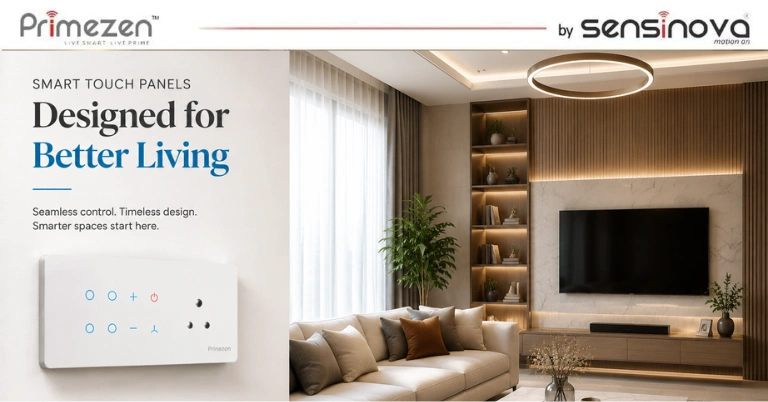
Primezen’s Zen Touch Panel range offers 2, 4, 6, and 8-module configurations — covering everything from a single light circuit to an entire room’s electrical control on one elegant panel.
Key features of touch panel switches:
- Capacitive touch operation — no physical button movement
- Tempered glass face — elegant, easy to clean
- LED indicator lights — easily visible in the dark
- Available in 2, 4, 6, 8 module configurations
- Can be wired into standard circuits (neutral required for most touch panels)
- Optional wireless RF integration
- No battery required (mains powered)
- Price: ₹800–₹4,000 per panel depending on modules

Touch Panel Switch vs Modular Switch: Feature-by-Feature Comparison
| Feature | Touch Panel Switch | Modular Switch |
|---|---|---|
| Operation | Capacitive touch (fingertip) | Mechanical press |
| Aesthetics | Premium — glass, flush, minimal | Functional — plastic, raised buttons |
| Durability | High (no moving parts) | High (robust mechanical contacts) |
| Indicators | Built-in LED glow | Optional separate indicator |
| Dark visibility | Excellent (LED glow lines) | Limited |
| Cleaning | Very easy — flat glass surface | Dust collects around button edges |
| Wiring compatibility | Needs neutral wire in most cases | Standard 2-wire compatible |
| Fault repair | Replace full panel | Replace individual module |
| Smart home upgrade | Easy RF/WiFi integration | Requires additional smart devices |
| Cost | ₹800–₹4,000 per panel | ₹300–₹2,500 per board |
| Child safety | Sensitive touch — accidental activation possible | Requires deliberate press |
| Power cut indicator | Useful — dark glass without LED | Normal appearance |
Where Touch Panel Switches Win
1. Aesthetics and Interior Design
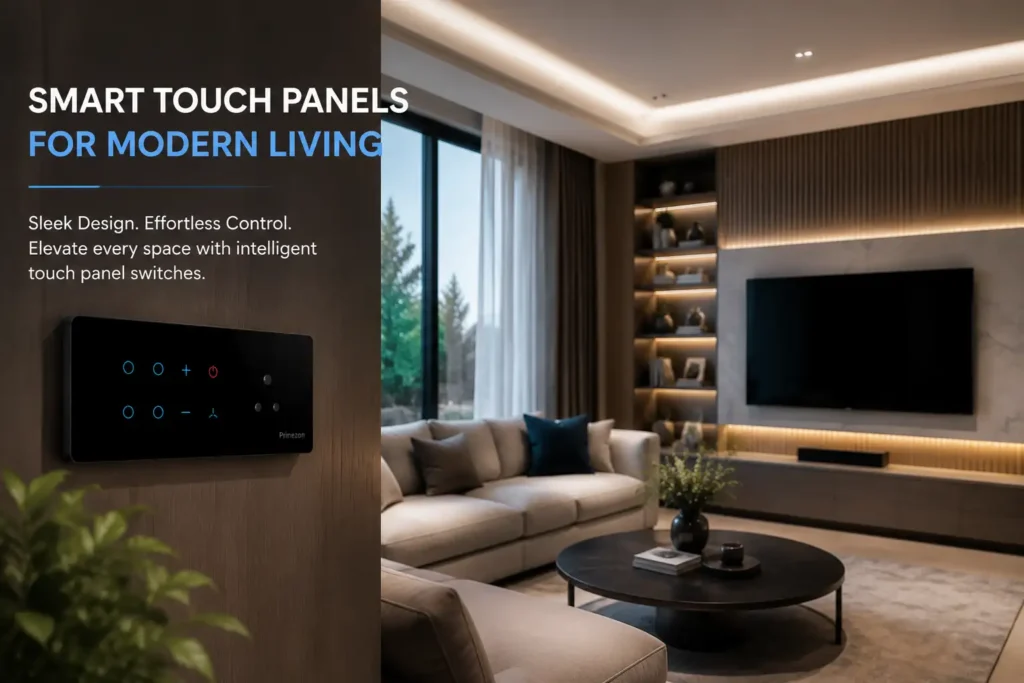
For premium homes, apartments with modern interiors, or any space where the electrical fittings contribute to the overall design, touch panels are unmatched. The flat glass surface, minimal profile, and soft LED glow create an effect that no modular switch can replicate. In a modern minimalist living room, an 8-module Primezen Zen Touch Panel controlling all the room’s lights and fans looks like an integrated design element — not an afterthought.2. Hygiene and Ease of Cleaning
Touch panels have a completely flat, smooth glass surface. Cleaning is a single wipe. Modular switches have button edges, gaps, and recesses where dust, grease, and bacteria accumulate. For kitchens, hospitals, clinics, and homes with hygiene priorities — touch panels are far superior.3. Durability of the Surface
Because there are no moving parts — no button that physically depresses with every use — touch panel surfaces have theoretically unlimited actuation life. The glass face is resistant to scratching, staining, and wear.4. Smart Home Integration
Primezen’s touch panels are designed for seamless integration with RF-based home automation. Adding wireless control, scene setting, or integration with the Primezen Zen Gateway for full smart home operation is straightforward when the base switches are touch panels.5. Night Visibility
The LED glow line on touch panel switches makes them instantly visible in a dark room without turning on any light — a practical advantage that homeowners consistently appreciate.Where Modular Switches Win
1. Cost for Large Properties
For a large home with 50+ switch points, the cost difference between touch panels and quality modular switches can be significant. Modular switches from premium brands are also good quality products — the cost saving with modular is real and relevant.2. Simple Circuit Compatibility
Many older homes and some new constructions do not have a neutral wire available at switch points. Touch panels typically require a neutral wire for their electronics. Modular switches work on standard 2-wire circuits without modification.3. Individual Module Replacement
If one module in a modular board develops a fault, you replace only that module. With a touch panel, a fault often means replacing the full panel (though panels are not particularly expensive).4. Familiar Operation for Elderly Family Members
Older family members accustomed to tactile feedback from a mechanical switch sometimes find touch panels counterintuitive initially. For households with elderly residents, this transition may require an adjustment period.The Verdict: Which Should You Choose for Your Indian Home?
Choose touch panel switches if:- You are building a new home or doing a complete renovation (neutral wires are easiest to add during construction)
- Aesthetics and premium finish are a priority
- You want smart home compatibility from the start
- You value hygiene and easy cleaning
- Your home is a premium apartment, villa, or show home
- You are upgrading an existing home where adding neutral wires is impractical
- Budget is a primary constraint across many switch points
- You prefer a widely available, easily serviceable product
- The home is a rental property or investment property
Primezen’s Zen Touch Panel: Designed for Indian Homes
Primezen’s Zen Touch Panel range is engineered for India’s specific conditions:- Tempered glass front for heat, humidity, and dust resistance
- Built-in surge protection for Indian power quality
- Available in 2, 4, 6, and 8 module configurations
- Compatible with standard loads (fans, lights, AC, geysers)
- RF wireless module available for smart home integration
- Elegant white glass aesthetic suits all interior styles
Frequently Asked Questions
Q1. Can touch panel switches work without a neutral wire?
Some touch panel switches (including certain Primezen models) are designed to work without a neutral wire — using a minimal current flow through the load circuit to power the electronics. However, for reliable performance and full feature availability, neutral wiring is recommended. Consult a Primezen-authorised electrician to assess your specific circuit.
Q2. Are touch panel switches safe for children?
Touch panels respond to a gentle touch, which means young children can accidentally activate them. However, this is not a safety hazard — it is an inconvenience. For specific circuits (geysers, outdoor sockets), additional smart home safety locks can be configured with Primezen’s system.
Q3. What is the lifespan of a touch panel switch?
Quality touch panel switches like Primezen’s Zen range have rated lifespans of 100,000+ touch operations — far more than any domestic switch would accumulate in normal use. The electronics are designed for 10+ years of reliable operation.
Q4. Can I install touch panel switches myself?
Electrical work in India should be performed by a licensed electrician. Touch panel switches require correct neutral and line wiring — incorrect installation can damage the panel or cause electrical hazards. Primezen provides installation support through authorised dealer and installer networks.
Q5. Do touch panel switches work during a power cut?
No — touch panel switches require mains power for their electronics. During a power cut, the switches are offline (no LED glow, no touch response). This is no different from modular switches, which also have no function without power.
Q6. Are Primezen touch panels available in Vadodara?
Yes — Primezen products are available across Gujarat including Vadodara, Ahmedabad, Surat, and other cities. Contact Primezen at primezen.in for dealer and installer locations near you.
Conclusion
Touch panel switches represent the direction Indian home design is heading — towards cleaner, smarter, and more elegant interiors. For new construction and premium renovations in 2026, the case for Primezen’s Zen Touch Panels is compelling.
For existing homes with budget constraints or older wiring, modular switches remain a practical and reliable choice for many switch points.
The smartest approach: plan your touch panel installation from the start of construction, and let Primezen help you design a system that delivers both the aesthetics and the smart home capability your home deserves.
🌐 primezen.in | Contact your nearest Primezen dealer in Vadodara